
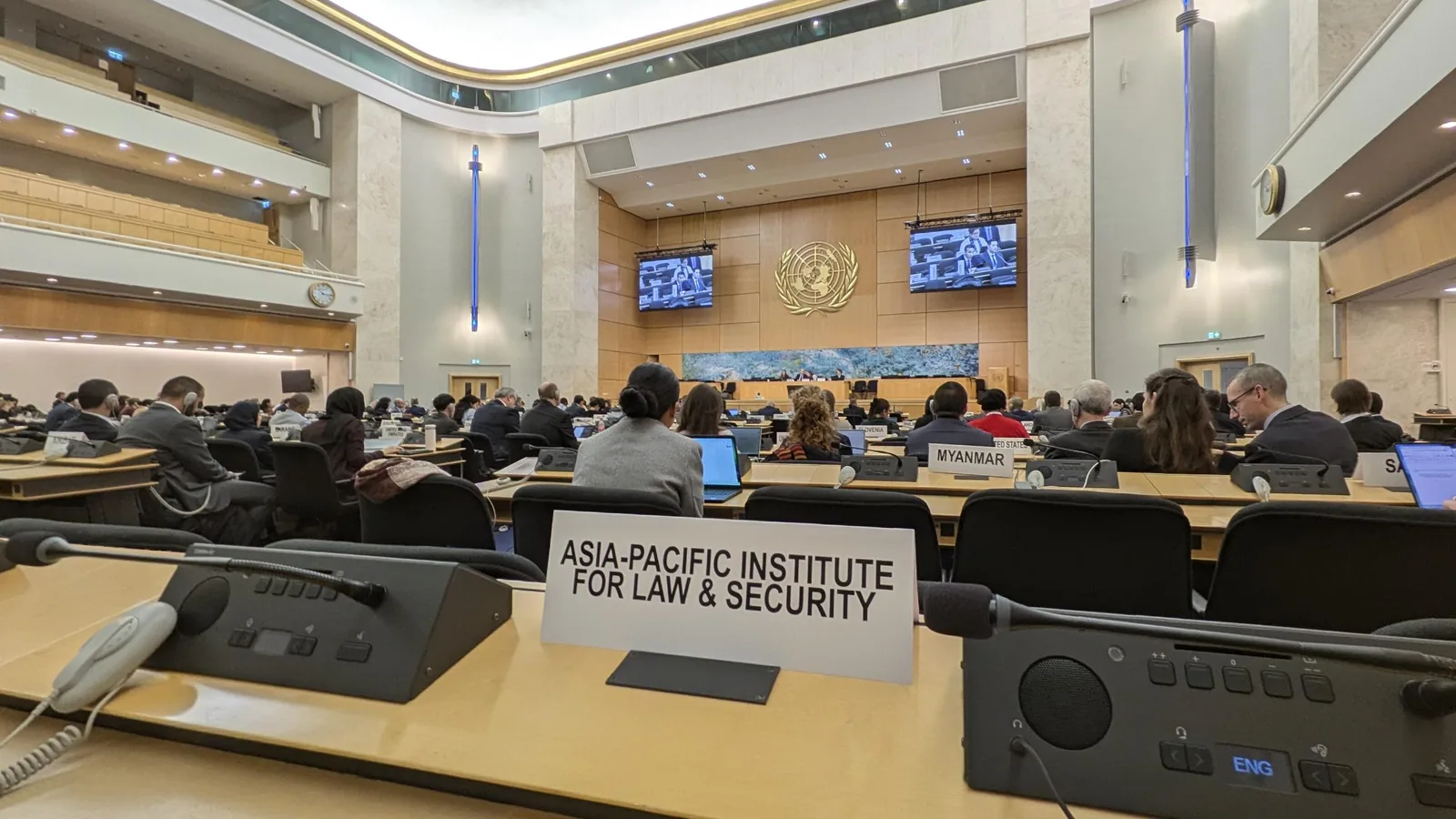
The Seventh Review Conference of the Convention on Certain Conventional Weapons (CCW) met in Geneva from 16 to 20 November 2026. Review Conferences are held every five years. Their main task is to review how the Convention and its annexed Protocols are operating, consider developments in weapons and warfare, and set the programme of work for the next five years.
The future of the work on lethal autonomous weapon systems (LAWS) dominated this Review Conference. In September 2026, the Group of Governmental Experts (GGE) on LAWS adopted a set of elements of an instrument. The Conference had to decide what should happen next.
Other questions about the operation of the Convention were also on the table. These included the resourcing of the CCW’s Implementation Support Unit; the humanitarian harm caused by incendiary weapons and the scope of Protocol III; the risks that anti-vehicle mines pose to civilians; how the CCW should keep track of developments in science and technology; and the long-standing goals of universal adherence and better compliance reporting.
A procedural dispute immediately derailed the Conference. The Russian Federation demanded restrictions on the participation of observers. When other High Contracting Parties refused to give in to those demands, Russia blocked consensus on the agenda and the rules of procedure. Without them, the Conference could only proceed through informal consultations. These procedural difficulties, combined with intense discussions on LAWS, meant the Conference failed to review the Convention and its Protocols, which is its main purpose. High Contracting Parties and observers submitted some 40 working papers, many apparently in place of statements that could not be delivered in a formal setting. By the time the meeting closed, only a handful of these working papers had been made public.
On LAWS, the Conference gave the GGE a mandate:
to elaborate, by consensus, an instrument, without prejudging its nature, that specifies international humanitarian law, including principles and requirements, applicable to lethal autonomous weapon systems, and its implementation, and other possible measures.
The Group will meet in 2027 and 2028, and build on the elements it adopted in 2026. The Group was asked to make a recommendation, in its report to the 2028 Meeting of High Contracting Parties, on the legal nature and form of the instrument, including whether it should be adopted as a binding protocol.
We are disappointed that a clear mandate to negotiate a legally binding instrument proved impossible. As we argued in our joint statement with Utrecht University, the elements adopted in 2026 are a sound starting point for negotiating a new CCW protocol. The new mandate keeps that path open, and we will continue to work with states to help them progress towards a protocol.
In a separate statement, we had welcomed the work of the Implementation Support Unit and suggested that consultations on Protocol III on incendiary weapons would be useful, given the continuing challenges in applying it.